Star Trek: Voyager is kind of the whipping boy of the Star Trek community. The people who didn't like DS9 or ENT simply avoided them, while Voyager offered a sort of perpetual hope that it would improve, so more people stuck through it than other Treks.
I was originally among the haters, but since Anna had fond memories of Voyager, and we are kind of on a completionist kick. My earlier conceptions have been confirmed, but I've been enjoying it more than I used to.
Voyager's biggest problem is that it was set up to be a serial, but ended up being the most episodic show of the modern-era Treks. In terms of sheer quality, it's not that far from DS9, and closer to TNG than it seems. In terms of fulfilled potential, it's extremely low.
The acting: On a character-by-character basis, the case of Voyager is very strong. Janeway, Tuvok, the Doctor, Kes, and especially Seven are all very strong actors, with B'Elanna and Tom right behind. Neelix is sabotaged beyond all hope by terrible writing, and Kim should have been killed off instead of Kes.
Chakotay is much better than I remember, at least in the first four or so seasons. He is a victim of bad writing as well, as other than the 'otherness' of his being Native American he has very little depth. His spirituality is occasionally used to good purpose, but not enough. As the seasons progress he becomes more and more a cipher (turning in fewer and fewer good performances). His relationship with Janeway, when they actually develop it, is one of the strongest of the series: Janeway is able to have a less-hierarchical relationship relationship with him than she does with any other member of the crew (except Seven, who eventually replaces him as the-person-who-has-a-relationship-with-Janeway).
So, the problem is not the cast. What about the plot?
The plot is not the problem. In fact, if you described the premise of each show to a person who knew nothing of the execution of the show, Voyager is by far the best. The Maquis-Starfleet crew combination is a perfect way to generate tension--TNG was great, but there was little inter-personal conflict. The 'journey home' aspect ensures that the villains are not simply re-hashed TNG villains, keeping the canon intact but without any of the baggage that being a sequel entails. The scarcity of resources--something that normal Trek never has to deal with--is an actual problem. The scarcity of people cuts off one of the cheapest Trek (and otherwise) tropes: introducing a (good-guy) character and killing him off in order to resolve the plot.
The problem was the writing.
In particular, three problems: continuity, bad science, and a lack of originality.
Voyager ended up adopting the episodic nature of not only TNG, but TOS. It seemed like the studio was fine having one Trek telling a serialized story--DS9--but wanted a Trek that people could tune in to and not miss a beat. Now, I have nothing against episodic TV shows, but Voyager *needed* to maintain some continuity. The Maquis-Starfleet plot would have involved rapidly changing relationships, tensions over different issues that sometimes exploded into a plot point, and so on. Resource scarcity can allow for the crew to set, and achieve goals over many episodes. Travelling through the Delta quadrant can allow for some foreshadowing (kind of like they did with Borg space) and show a gradually changing alien landscape. On this same point, the lack of continuity let the writers allow for characters to become disconnected from one another. Sure, there were some relationships, Tom-B'Elanna, Tom-Kim, Janeway-Chakot/Seven, Neelix-Kes-Doctor, Doctor-Seven, and so on. But there were so many holes in the relationship-network. In TNG (and DS9 to a lesser extent), every character had some sort of unique relationship with the other members of the crew. Not the case in Voyager.
It's obvious that some among the writers wanted to promote continuity, as episodes like The Year of Hell and Course: Oblivion prove. But such glimpses of continuity only served to remind us what Voyager could have been normally.
Bad Science. This manifests in two forms. First, the techno-babble. Techno-babble, even more than killing off new characters, is a plot crutch. A good plot confronts the characters with a challenge, and requires that characters come up with some creative resolution or make some sacrifice in order to solve the problem.
Because techno-babble decreases the price of one sort of resolution, it allows for the creators to 'produce' more 'problem,' in other words letting the writers get the characters into and out of bigger problems. This leads to an unfortunate spiral (that started in TNG), where drama requires problems of increasing intensity, and increasingly contrived solutions. This ultimately makes it impossible for the writers to credibly commit to danger or drama of any type.
The science itself is also terrible, especially regarding DNA and Evolution. The infamous 'Threshold,' where Paris and Janeway exceed Warp 10 (to infinity- and beyond! To hell with evolution, basic fractions escape the writers. If you exceed infinite speed, this means that you travel and infinite distance in some finite length of time. They would never have seen the Delta Flyer again). They then turn in to lizard people from their DNA changing. The writer of that episode, Brandon Braga, stated that he wanted to convey that 'evolution doesn't always go forward - it can go backwards too!' In Distant Origin, Voyager 'simulates what a dinosaur would look like if it evolved for another 300 million years.' The 'progressive modernist' view of history is annoying enough, a 'progressive modernist' view of evolution (evolution without selection, a.k.a., not evolution) is worse.
The lack of creativity manifests itself in two places, one of which is more obvious looking back than it is now. One is a lack of technological change. It's been joked elsewhere, that some of the most life-changing technologies in our lives are completely missing from Star Trek. Social media (#ShitSiskoSays), interactive display devices (for more than reading), any sort of technology that makes people 'better,' or cyborgy, is completely lacking from Voyager. I don't expect these exact things (but human modification seems a no-brainer, especially with the precedent of Geordi), but the only technological advances that Voyager makes are 'in universe' advances and not 'lifestyle' advances. Bioneural gel, Slipstream drive, etc, are all 'advances' that have zero implications for the characters.
The second creativity failure is in the failure to produce a good Delta Quadrant culture. They tried with the Kazon, but 1) They hung around for *TWO YEARS* going at high warp. The same Kazon. and 2) the Kazon sucked. What would it be like to travel across the United States on foot? There are certainly distinct cultures, but the change is gradual, people know the surrounding area, and have relationships with each other. In Voyager, it's a little bit like stepping from the Bronx into downtown San Francisco, then the next block is Amish country, and so on. And then you get to the Borg. Kind of.
To be fair, there are quite a good number of 'creative' episodes which are really good. The episodic nature of Voyager allows it to come up with a really good stand-alone now and then (while Enterprise and DS9 had to deal with both the arc and the episode, for the most part). I'll come up with a list of them soon. It's probably as long as DS9's list.
Next time: What should Voyager have been?

Wednesday, March 20, 2013

Wednesday, February 13, 2013
the internet teached me this
Look what happens when you cut off the bottom of bok choy (or celery, or green onions) and stick it in some water for a couple of weeks. Neat!


Tuesday, February 12, 2013
Ryan Reviews: Star Trek Reviews

*Ahem*
Now that that's done...
Anna and I have been watching Star Trek over the last couple months--all of Star Trek. Yes, even Star Trek V (though Anna skipped that one).
When watching shows like Star Trek, where the episode-to-episode quality varies so much, it's worth keeping an eye on episode reviews so that you can avoid the big stinkers, even if sometimes your terrible wife makes you watch Threshold anyways.
I've been following some of these guys since High School (though by this point only Enterprise was left), and if you just want to avoid the bad episodes just about anything will do (though if you're a big fan then you instinctively know the bad episodes). It's not enough to just read the Netflix summaries, because sometimes the worst ideas can turn into pretty good episodes (Tuvix?).
Now, the candidates:
Tim Lynch Reviews
Tim Lynch reviewed episodes as they aired, starting with "The Icarus Factor" in season 2 of TNG, and continued through DS9 and season 2 of Voyager (he quit on it). He came back to review the first two seasons of Enterprise, but quit on that as well (due to lack of time, not because of the quality). In doing so, he gained a bit of a name in the Star Trek community--in First Contact, they named the Ensign that Picard mows down with a machine gun after him (perhaps a subtle hint as to their opinion of his reviews?).
Links: TNG Reviews, DS9 Reviews, VOY Reviews, The Enterprise reviews are scattered through this archive
He reviews each episode as it airs, and at the end of the season re-watches (and re-rates) each episode and offers commentary on the entire season.
CONS:
The reviews are scattered, and where aggregated are not well presented. This is a bummer if you want to glance at a season to see the episodes to watch/avoid.
Incomplete: He starts TNG late and ends VOY and ENT early; no late movies or TOS.
He gave "Manhunt" 9.5/10.
PROS:
The reviews include a full synopsis, so if you've forgotten what happens you'll get a full review.
Done in real time, so you get a picture of what people thought at the time--the optimism that writers will follow up on character development, a fog over the future.
High Quality reviews, plus full season Synopses. Excellent commentary on the direction of the shows, especially in DS9.
Jammer's Reviews

PROS:
He's reviewed everything. TOS, TNG (except the last five episodes), VOY, DS9, ENT. Plus! BSG and Andromeda.
The website is very good. You can tell at a glance where the one, zero star episodes are.
CONS:
While the reviews are solid, they never make me reconsider the episodes like Lynch's sometimes do, though he sometimes articulates my thoughts about episodes better than I would.
The TNG and early DS9 episodes were written way after the fact, by someone who had seen them all several times before. On the one hand, this gives him more time to think about each episode--but it's also a perspective that people watching now would have.
He hates The Royale, which I always thought was quite a fun episode.
TV.com
This website has an episode guide for just about every TV show, and user reviews for each episode therein.
TOS - TNG - DS9 - VOY - ENT
PROS:
The format is very pretty.
Everything's available.
If you like to see dissenting opinions, this forum allows that.
CONS:
Call me an elitist. Review sites that stand the test of time survive by offering quality opinions. Some people don't have opinions worth listening to. Compare the quality of a newspaper article to the quality of the comments on a large blog. Frankly, I find many of the episode ratings odd--though the best and worst episodes tend to stand out. Some good episodes get rated poorly and vice versa.
There is no consistent voice throughout the reviews, and rarely do they offer much insight.
Suggestions
If you enjoy reading another's informed opinion of what you just watch, go for the Tim Lynch reviews where available. If you're just trying to avoid landmines, Jammer's Reviews is the best because of its format and generally high quality evaluations.
Also: The Cynics Corner, limited reviews of VOY/DS9/ENT, written as they aired. These are fun, but there aren't enough of them to use unless you happen to be in the seasons he reviews. Good for the Voyager episodes that Tim Lynch doesn't get to. They're actually very hilarious.
EDIT: Reading through the Cynic's Corner, I have to add a PRO to each of the above. They are all Star Trek fans, and interpret the episodes in a fairly favorable light. The Cynic's Corner, on the other hand, finds a little too much fault.
Monday, February 11, 2013
Ryan Reviews: Introduction and Stranger in this Town
Greetings, readers! I know this blog has not been very active for a long time, but I hope that we can change that in the coming days.
I am introducing new segment called 'Ryan Reviews.' It will be a forum where I talk about whatever I feel like: I'll review music, movies, tv shows, books, beers, board games, and perhaps I will even review some reviews? Who knows, things might get freaky. It will be fun to see Anna's reviews of things as well!
As I am currently, professionally dedicated to other sorts of writing, when these appear you will know that I have reached some sort of block, and am hoping that this sort of writing clears that block.
Anyways: onward and upward!
------
A Theory of Music Reviews.
When we review music, what is the object of the review (and what should the object of our review be?) Indeed, I go back and forth on this. Should the unit 'song' be what the artist strives for? Or should it be 'album,' such that each song is a part of a whole, and the goal is to rise above the sum of the parts?
I don't know the answer to that question, and there really isn't one in the first place. There's no accounting for taste, really.
But, to account for taste, my music reviews will take the following format:
Each song will get 1-3 points in each of the following categories:
Lyric Quality:
1 stands for "I would be embarrassed to sing this in public, for other than the usual reasons."
2 for "Not great, but not the source of too many eyerolls."
3 for "I actually would listen to this song for its lyrics."
Music Quality and Performance Quality go along the same lines. I don't entirely know what criteria I'll use to judge these other than my gut, but perhaps a pattern will emerge in the process of the reviews.
In addition, there are two bonus points:
One for rising above the sum of its parts as a song, either by having its parts be so bad it sounds good, or by the components reinforcing each of the other ones.
One for its context in the album: is this song enhanced by its surrounding songs? Pinball Wizard, for instance, is a different song depending on whether you listen to it on Tommy or if you listen to it on a greatest hits album/iTunes shuffle.
So, the rating system for songs goes to 11.
For albums, I will simply take the scores of the top nine songs on the album. The other songs will influence the score indirectly, by subtracting or adding to the songs that do count. The high score is 99, so no album can be a perfect 100.
As you can tell, I like albums that have good songs more than I care about an album being put together well. That's what happens when you are raised with iTunes.
Also, this rating system only works given the Rock Album format. Beethoven's 9th and Chocolate Starfish and the Hotdog Flavored Water need different rating scales.
DISCLAIMER: I have a terrible taste in music. My favorite band is Bon Jovi, and I have a very high tolerance for cheesiness (but I repeat myself). You have been warned.
-----
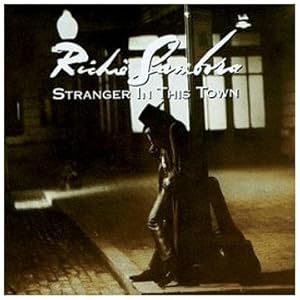
Richie Sambora 1991: Stranger in this Town

A YouTube Playlist of the Album, in case you want to listen along.
For those not in the know, Richie Sambora is the guitarist for Bon Jovi. He's released three solo albums so far: Stranger in this Town, Undiscovered Soul (1998), and Aftermath of the Lowdown (2012), in descending order of quality, I think.
In Brief: This is the album that got me thinking about the album/song question. I love this album, but none of the songs make it into my 'most listened' list. The album starts with sixsongs that are meant to be listened to together: "Rest in Peace," of little value on its own, sets the mood for the subsequent songs to play off of. Sambora's guitar, and the music, sounds more Blues/Blues-Rock, in contrast to Bon Jovi's Pop-Rock-Metal sound, which fits, because he's complementing his own voice instead of Jon Bon Jovi's. "Mr. Bluesman" is the musical highlight of the album, featuring a solo by Eric Clapton, while "Stranger in this Town" is the best song overall, followed by "Father Time." After the sixth song, the album stops sounding like a unified whole, which is mostly because "Rosie" was originally written as a Bon Jovi song. and "River of Love" sounds like a silly Jovi B-Side. While enjoyable, it doesn't quite fit in with the rest. The album as a whole would have worked better if 7-9 were excised ("Father Time" perhaps remaining as a postscript). Richie's voice is pedestrian, but it pairs well with his guitar style here, when sticking to his own style.
1. "Rest in Peace" 3:47
Lyrics: 2 Music: 2 Performance: 2 Bonus: Album(1) Total: 7
2. "Church of Desire" 6:08
L: 2 M: 2 P: 2 A:1 T: 7
3. "Stranger in This Town" 6:15
L: 3 M: 2 P: 2 A:1 Bonus: 1 T: 9
The best song on the album, I think.
4. "Ballad of Youth" 3:52
L: 2 M: 2 P: 2 A:1 T: 7
5. "One Light Burning" 5:48
L: 2 M: 2 P: 2 A:1 T: 7
6. "Mr. Bluesman" (Solo by Eric Clapton) 5:14
L: 2 M: 2 P: 3 A:1 T: 8
7. "Rosie" Sambora, Jon Bon Jovi, Desmond Child, Diane Warren 4:49
L: 2 M: 2 P: 2 T:6
8. "River of Love" 4:06
L: 1 M: 2 P: 1 T:4
"Let me be your preacher
And you can be my whore"
Yeah
9. "Father Time" 6:05
L: 3 M: 2 P: 3 Bonus: 1 T:9
Taken on it's own, my favorite song here. Doesn't contribute to the album as well as "Stranger," though.
10. "The Answer" 5:07
L: 2 M: 2 P: 1 T:5
A bit boring. It would have made a good closer to the album after "Mr. Bluesman," but it's kind of stranded out here.
Overall: 65
We'll see if my rating system gives enough of a standard deviation to be useful.
The song ratings seem to be:
5 or less - blah to bad.
6-7 - listenable
8-9 - enjoyable
10-11 - favorite.
We'll see on the album ratings.
I am introducing new segment called 'Ryan Reviews.' It will be a forum where I talk about whatever I feel like: I'll review music, movies, tv shows, books, beers, board games, and perhaps I will even review some reviews? Who knows, things might get freaky. It will be fun to see Anna's reviews of things as well!
As I am currently, professionally dedicated to other sorts of writing, when these appear you will know that I have reached some sort of block, and am hoping that this sort of writing clears that block.
Anyways: onward and upward!
------
A Theory of Music Reviews.
When we review music, what is the object of the review (and what should the object of our review be?) Indeed, I go back and forth on this. Should the unit 'song' be what the artist strives for? Or should it be 'album,' such that each song is a part of a whole, and the goal is to rise above the sum of the parts?
I don't know the answer to that question, and there really isn't one in the first place. There's no accounting for taste, really.
But, to account for taste, my music reviews will take the following format:
Each song will get 1-3 points in each of the following categories:
Lyric Quality:
1 stands for "I would be embarrassed to sing this in public, for other than the usual reasons."
2 for "Not great, but not the source of too many eyerolls."
3 for "I actually would listen to this song for its lyrics."
Music Quality and Performance Quality go along the same lines. I don't entirely know what criteria I'll use to judge these other than my gut, but perhaps a pattern will emerge in the process of the reviews.
In addition, there are two bonus points:
One for rising above the sum of its parts as a song, either by having its parts be so bad it sounds good, or by the components reinforcing each of the other ones.
One for its context in the album: is this song enhanced by its surrounding songs? Pinball Wizard, for instance, is a different song depending on whether you listen to it on Tommy or if you listen to it on a greatest hits album/iTunes shuffle.
So, the rating system for songs goes to 11.
For albums, I will simply take the scores of the top nine songs on the album. The other songs will influence the score indirectly, by subtracting or adding to the songs that do count. The high score is 99, so no album can be a perfect 100.
As you can tell, I like albums that have good songs more than I care about an album being put together well. That's what happens when you are raised with iTunes.
Also, this rating system only works given the Rock Album format. Beethoven's 9th and Chocolate Starfish and the Hotdog Flavored Water need different rating scales.
DISCLAIMER: I have a terrible taste in music. My favorite band is Bon Jovi, and I have a very high tolerance for cheesiness (but I repeat myself). You have been warned.
-----
Richie Sambora 1991: Stranger in this Town
A YouTube Playlist of the Album, in case you want to listen along.
For those not in the know, Richie Sambora is the guitarist for Bon Jovi. He's released three solo albums so far: Stranger in this Town, Undiscovered Soul (1998), and Aftermath of the Lowdown (2012), in descending order of quality, I think.
In Brief: This is the album that got me thinking about the album/song question. I love this album, but none of the songs make it into my 'most listened' list. The album starts with sixsongs that are meant to be listened to together: "Rest in Peace," of little value on its own, sets the mood for the subsequent songs to play off of. Sambora's guitar, and the music, sounds more Blues/Blues-Rock, in contrast to Bon Jovi's Pop-Rock-Metal sound, which fits, because he's complementing his own voice instead of Jon Bon Jovi's. "Mr. Bluesman" is the musical highlight of the album, featuring a solo by Eric Clapton, while "Stranger in this Town" is the best song overall, followed by "Father Time." After the sixth song, the album stops sounding like a unified whole, which is mostly because "Rosie" was originally written as a Bon Jovi song. and "River of Love" sounds like a silly Jovi B-Side. While enjoyable, it doesn't quite fit in with the rest. The album as a whole would have worked better if 7-9 were excised ("Father Time" perhaps remaining as a postscript). Richie's voice is pedestrian, but it pairs well with his guitar style here, when sticking to his own style.
1. "Rest in Peace" 3:47
Lyrics: 2 Music: 2 Performance: 2 Bonus: Album(1) Total: 7
2. "Church of Desire" 6:08
L: 2 M: 2 P: 2 A:1 T: 7
3. "Stranger in This Town" 6:15
L: 3 M: 2 P: 2 A:1 Bonus: 1 T: 9
The best song on the album, I think.
4. "Ballad of Youth" 3:52
L: 2 M: 2 P: 2 A:1 T: 7
5. "One Light Burning" 5:48
L: 2 M: 2 P: 2 A:1 T: 7
6. "Mr. Bluesman" (Solo by Eric Clapton) 5:14
L: 2 M: 2 P: 3 A:1 T: 8
7. "Rosie" Sambora, Jon Bon Jovi, Desmond Child, Diane Warren 4:49
L: 2 M: 2 P: 2 T:6
8. "River of Love" 4:06
L: 1 M: 2 P: 1 T:4
"Let me be your preacher
And you can be my whore"
Yeah
9. "Father Time" 6:05
L: 3 M: 2 P: 3 Bonus: 1 T:9
Taken on it's own, my favorite song here. Doesn't contribute to the album as well as "Stranger," though.
10. "The Answer" 5:07
L: 2 M: 2 P: 1 T:5
A bit boring. It would have made a good closer to the album after "Mr. Bluesman," but it's kind of stranded out here.
Overall: 65
We'll see if my rating system gives enough of a standard deviation to be useful.
The song ratings seem to be:
5 or less - blah to bad.
6-7 - listenable
8-9 - enjoyable
10-11 - favorite.
We'll see on the album ratings.
Sunday, January 27, 2013
Buckwheat Chocolate Chip Peanut Butter Cookies
It's eat-through-the-pantry-time here, so I decided to make cookies from some of the food we have in excess. Two of those things are peanut butter and Bob's Red Mill Buckwheat Pancake Mix. I cobbled together a few different recipes and the results are pretty tasty. And thanks to the buckwheat pancake mix, a little healthier than your average cookie. Here are the resulting buckwheat chocolate chip peanut butter cookies.


1 c. peanut butter
1/2 c. butter, softened
2 eggs
1 c. brown sugar
3/4 c. buckwheat pancake mix (Bob's Red Mill)
1 1/2 tsp vanilla
1/4 tsp cinnamon (more or less to taste)
1 c. chocolate chips
Preheat oven to 350 degrees.
Cream together peanut butter, butter and sugar. Add eggs and vanilla until well blended. Add buckwheat pancake mix and cinnamon. When well combined, add chocolate chips.
The dough will be fairly thick/dry but that's okay. Form dough into balls - the heat of your hands should soften the dough. Flatten a little or use fork to make crosshatch.
Bake for 13-15 min. Enjoy!
Monday, July 16, 2012
The Mild Imperialist and Hard Cider
Just a quick brewing update:
Just bottled an All Grain kit from Northern Brewer, the 'Surly Bender,' the recipe is here. O.G. Was 1.057, F.G. 1.010, using the British Ale II Wyeast. Brewed mid-May, bottled yesterday, so about two months in the primary.
Planning on doing two batches, upcoming: an American Pie beer (Nut brown w/cider and cinnamon) and, perhaps, an Apple Cider with Maple Syrup and Brown Sugar?
My plan right now with the cider is to brew a 5 gallon batch, then at bottling do three variants: one with no added sugar, one with Splenda(brown sugar splenda?) and a third with Erythritol or Xylitol or some other non-fermentable sugar. Anna (and I) tend to like the sweeter ciders, and it's hard to get that without killing the yeast.
Just bottled an All Grain kit from Northern Brewer, the 'Surly Bender,' the recipe is here. O.G. Was 1.057, F.G. 1.010, using the British Ale II Wyeast. Brewed mid-May, bottled yesterday, so about two months in the primary.
Planning on doing two batches, upcoming: an American Pie beer (Nut brown w/cider and cinnamon) and, perhaps, an Apple Cider with Maple Syrup and Brown Sugar?
My plan right now with the cider is to brew a 5 gallon batch, then at bottling do three variants: one with no added sugar, one with Splenda(brown sugar splenda?) and a third with Erythritol or Xylitol or some other non-fermentable sugar. Anna (and I) tend to like the sweeter ciders, and it's hard to get that without killing the yeast.
Sunday, April 29, 2012
Star Trek: The Next Generation I
Little and I have just finished (re)-watching Star Trek: The Next Generation, except for Nemesis and a couple episodes I just could not bring myself to rewatch (Shades of Grey, Aquiel). It was a fairly long process, spanning a couple months (I think?), unlike things like Buffy, where we just chewed through them. Both Little and I got distracted from finishing, moving between series (the most recent being Little's obsession with Korean Dramas). But, after watching All Good Things on Thursday and Generations/First Contact/Insurrection yesterday, we made a final push.
Some brief thoughts:
Generations was a lot better than I remembered it. Not nearly as good as First Contact, granted, but probably the best of the 'odd' movies. The weakest part of the story was the attempt to unite the two crews, but I guess that had to be done. Picard was exceptional, though I wish he and Guinan had advanced their relationship a bit more. She, as is often the case, was just the mysterious guru used to advance the plot. Her escape from the Borg was an interesting aspect of her character, but we didn't get to feel any of those implications. Data was a little too much of a sideshow, and they didn't really follow up on the implications for Geordi and his relationship after Data fails to save him.
The weakness of relationship development runs through the movies, I think. The characters who are defined primarily by their relationships to the major characters - especially Beverly, but also Geordi - become non-entities. Movies also seem to be weaker for advancing interpersonal relationships, which is probably the reason I prefer TV to movies. The exception is Deanna and Riker starting in Insurrection - that was good fun.
Perhaps more later.
Some brief thoughts:
Generations was a lot better than I remembered it. Not nearly as good as First Contact, granted, but probably the best of the 'odd' movies. The weakest part of the story was the attempt to unite the two crews, but I guess that had to be done. Picard was exceptional, though I wish he and Guinan had advanced their relationship a bit more. She, as is often the case, was just the mysterious guru used to advance the plot. Her escape from the Borg was an interesting aspect of her character, but we didn't get to feel any of those implications. Data was a little too much of a sideshow, and they didn't really follow up on the implications for Geordi and his relationship after Data fails to save him.
The weakness of relationship development runs through the movies, I think. The characters who are defined primarily by their relationships to the major characters - especially Beverly, but also Geordi - become non-entities. Movies also seem to be weaker for advancing interpersonal relationships, which is probably the reason I prefer TV to movies. The exception is Deanna and Riker starting in Insurrection - that was good fun.
Perhaps more later.
Subscribe to:
Posts (Atom)